

How to Build a Lead List That Converts
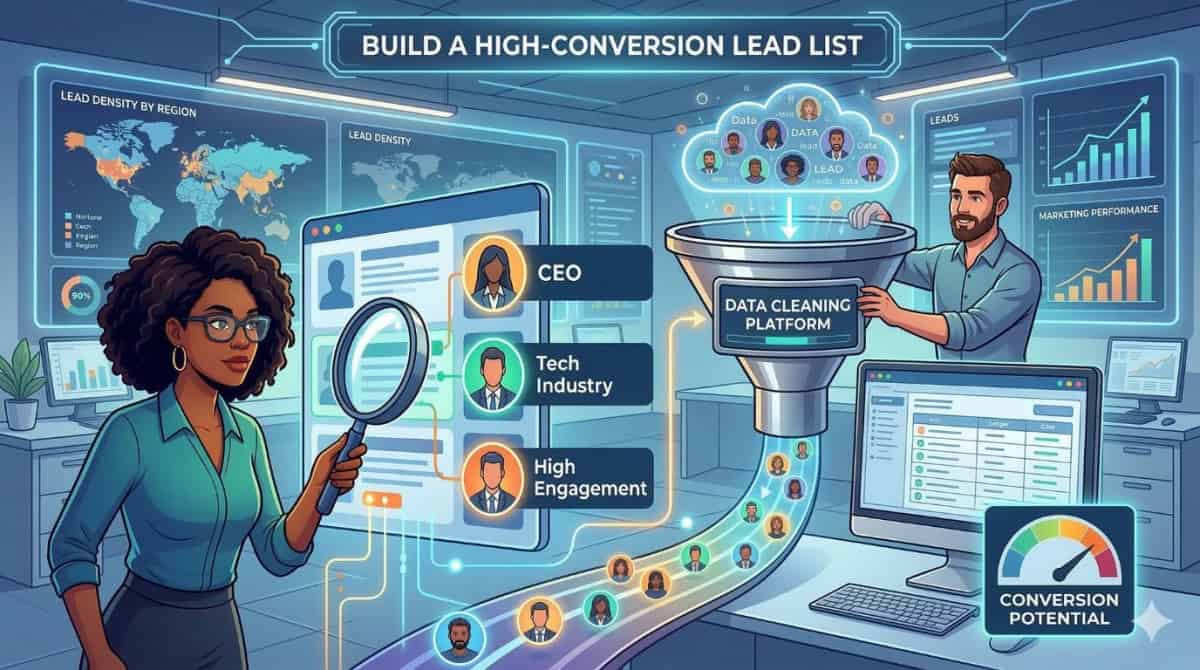
Building a truly effective lead list in today’s competitive business landscape is less about the sheer volume of contacts and more about the quality of those connections. As business owners and marketing directors, you’re tasked with driving sustainable growth, and that starts with identifying and engaging with the right potential customers.
Understanding how to build a lead list that converts is essential for achieving this goal. In this article, we will delve deep into the strategies that will help you build a lead list that doesn’t just look good on paper but actively contributes to your bottom line. You’ll learn how to move beyond generic outreach and focus on attracting individuals and companies genuinely interested in what you offer, thereby increasing your conversion rates and getting more qualified meetings booked.
The Foundation: Understanding Your Ideal Customer
Before you start collecting contacts, it’s important to understand that how to build a lead list that converts begins with a clear strategy and a deep understanding of your target audience.
Defining Your ICP with Precision
Your ICP isn’t just a demographic snapshot. It’s a detailed picture of the companies that benefit most from your products or services, and the individuals within those companies who are most likely to become champions for your solution. What firmographic data is crucial? This includes industry, company size, annual revenue, and geographical location. But don’t stop there. What are their pain points? What are their strategic goals? What challenges are they trying to overcome that your offering can address? This level of detail is where the magic happens. It allows you to tailor your messaging and your outreach with surgical precision.
For a deeper understanding of how to define and research your ideal customer profile, you can explore this guide.
Consider a software company selling project management tools. Their ICP might be mid-sized marketing agencies (50-200 employees) struggling with client project timelines and interdepartmental communication. The individuals within these agencies who are most relevant would be Marketing Directors, Operations Managers, and Agency Owners. Understanding their specific headaches – missed deadlines, scope creep, client dissatisfaction – will inform every piece of marketing you create.
Recency: The Time Factor in Lead Quality
Beyond who your ideal customer is, it’s also important to consider when they are most likely to be in a buying cycle. Recency is key. Are you targeting companies that have recently looked for solutions like yours? Or those that have undergone significant organizational changes (like a merger or acquisition) that might necessitate new tools or services? Many lead generation efforts overlook this temporal dimension.
Tools that identify website visitors, for instance, can provide valuable insights into which companies are actively exploring your solutions. This isn’t about intrusive surveillance; it’s about understanding genuine interest. If a company from your target industry spends significant time on your pricing page or case studies demonstrating ROI, their intent is much higher than someone who just landed on your homepage and bounced. Targeting these high-intent accounts allows you to focus your resources on prospects that are exhibiting behaviors indicating a readiness to engage.
If you’re looking to enhance your lead generation strategies, you might find the article on “Effective Email Marketing Techniques for Lead Conversion” particularly useful. It delves into how to craft compelling emails that resonate with your target audience, ultimately driving higher conversion rates. To explore this insightful resource, visit here.
Crafting Irresistible Lead Magnets and Content
Once you know who you’re talking to and what their needs are, the next step is to create something of value that entices them to share their contact information. This is where your lead magnets and content strategy come into play. Think of lead magnets as the irresistible appetizers that draw potential customers in. They need to be substantial enough to warrant an exchange of information, but not so overwhelming that they deter engagement.
Creating valuable content is another crucial part of how to build a lead list that converts, because high-quality resources attract prospects who are genuinely interested in solving the problems your business addresses. Delving deep into a specific industry challenge, or a webinar offering actionable strategies to overcome a common pain point, can be extremely effective. These aren’t just generic brochures; they are carefully crafted pieces of content designed to solve a problem for your ICP. This problem-solving approach is paramount. When you offer genuine value, you build trust and position yourself as a knowledgeable resource from the outset, making it more likely that your leads will eventually convert.
The Power of Problem-Solving Content
Your content should directly address the pain points you’ve identified in your ICP. If your target audience is struggling with data security in a remote work environment, create content that offers solutions, best practices, and insights into this specific challenge. This could manifest as blog posts, detailed guides, infographics, or even short video tutorials. The goal is to become an indispensable source of information.
When you consistently provide high-quality, solution-oriented content, you naturally attract the right audience. This is the essence of inbound marketing, where potential customers find you because you offer the answers they are seeking. By optimizing your content for search engines using high-intent keywords – terms that indicate a user is close to making a purchase decision, rather than just browsing – you increase your visibility among those actively looking for solutions like yours. Think “best CRM for small businesses” versus “what is CRM?”.
Content Upgrades and Gated Assets
Within your valuable content, strategically place “content upgrades” or gate certain deeper resources. A content upgrade is a bonus piece of content related to the article a visitor is currently reading. For example, if someone is reading a blog post about social media marketing strategy, a content upgrade could be a downloadable social media calendar template or a checklist for optimizing ad campaigns. This makes the offer highly relevant and immediately useful.
Gated content, such as comprehensive e-books, in-depth case studies, or exclusive webinar recordings, require users to provide contact information to access. This is a direct method for building your lead list. The key is to ensure that the gated content delivers immense value, making the exchange feel fair and beneficial to the user. When done correctly, these methods can convert a significant percentage of your website visitors into qualified leads.
Designing Landing Pages for Maximum Conversion
Once you’ve enticed a visitor with your content, the next crucial step is to guide them through a clear and persuasive path to become a lead. This is the role of your landing page. A landing page is a standalone web page, created specifically for a marketing or advertising campaign. It’s where a visitor “lands” after they click on a link in an email, or ads from Google, Bing, or similar platforms. Your landing pages are the gatekeepers of your lead list, and their design has a direct impact on your conversion rates.
Think of your landing page as a highly focused salesperson. It has one job: to get the visitor to take a specific action, whether that’s filling out a form, requesting a demo, or downloading a resource. Every element on the page should work harmoniously towards this single goal. This means keeping it clean, uncluttered, and free from distractions that could pull the visitor away.
The Anatomy of a High-Converting Landing Page
Every high-converting landing page shares a common set of characteristics. First, it has a clear, compelling headline that immediately communicates the value proposition. Below this, concise and benefit-driven copy explains what the offer is and why is it relevant to the visitor’s needs. Strong visuals – images or videos – can enhance understanding and emotional connection. Most importantly, a prominent and easy-to-find call to action (CTA) guides the visitor on what to do next.
A common mistake is to include too many links or navigation elements on a landing page. This gives visitors too many options and can lead to them leaving without converting. Your landing page should be a focused experience, with the sole purpose of pushing the visitor towards your desired action. Test different headlines, copy variations, and CTA button text to see what resonates best with your audience.
Simplifying the Conversion Process
The form is often the biggest hurdle between a visitor and becoming a lead. Long, complex forms can be a significant deterrent, especially for mobile users. In 2026, we’re seeing a trend towards simplifying this process. Consider click-to-call or SMS-based lead capture options. For many businesses, especially those whose sales cycle involves direct consultation, offering a quick phone call or a text message opt-in can dramatically increase your mobile lead capture rates.
Mobile traffic often has high intent, and making it easy for them to connect with you on the go is crucial. If a click-to-call button directly connects them to a sales representative or a qualified lead development team, it’s a more frictionless experience than filling out a multi-field form on a small screen. This shift toward immediacy and ease of contact is a powerful way to boost your lead generation.
Leveraging Social Proof to Build Trust
People are more likely to trust and convert if they see that others have had positive experiences. Social proof, in the form of testimonials, case studies, customer logos, and reviews, is incredibly powerful on landing pages. If a potential client sees that companies similar to theirs, or well-respected brands, have used your services and achieved success, it significantly reduces perceived risk and builds confidence.
Display these elements prominently. A short, impactful testimonial from a satisfied client can speak volumes. A link to a detailed case study demonstrates tangible results. Client logos can provide instant credibility. When visitors feel confident that others have benefited, they are more likely to believe they will too, making them more inclined to take the next step.
Nurturing Your Leads: From Interest to Opportunity
Acquiring a lead is just the beginning of the journey. A raw lead is like a seed; it needs careful cultivation to grow into a valuable opportunity. This is where your lead nurturing strategy comes into play. Nurturing is the process of building relationships with prospects at every stage of the sales funnel, providing them with the information they need to make a purchase decision. It’s about guiding them gently towards a sale without being overly pushy.
The modern buyer is often well-researched and may not be ready to buy immediately. Effective nurturing ensures you stay top-of-mind and continue to provide value, positioning your company as the go-to solution when they are ready. A well-executed nurturing program can generate significantly more qualified leads than a simple “collect and sell” approach.
Segmenting Your Audience for Targeted Messaging
Not all leads are created equal, and they certainly aren’t all at the same stage of the buyer’s journey. Segmenting your email campaigns is non-negotiable for effective nurturing. Segmenting your audience based on their behavior, expressed interests, or where they are in the buying cycle allows you to send highly relevant and timely messages.
For example, a lead who downloaded a guide on “getting started with AI” will respond differently to an email than a lead who downloaded a “deep dive into AI integration for enterprise solutions.” By segmenting, you can tailor your messaging to match their specific needs and knowledge level. This personalized approach makes your communications feel less like generic marketing and more like a helpful conversation.
Personalization Beyond the First Name
Personalization is a cornerstone of effective B2B marketing. While using a prospect’s first name is a basic courtesy, true personalization goes much deeper. Reference specific actions they’ve taken, content they’ve interacted with, or even their industry challenges. If a prospect recently attended your webinar on cybersecurity, your follow-up email could reference a key takeaway from that webinar or offer a related piece of content.
This level of detail demonstrates that you’ve paid attention and understand their context. It makes your outreach feel more genuine and less like a mass email blast. Utilizing marketing automation tools can help you track these interactions and trigger personalized follow-ups automatically, ensuring no lead falls through the cracks.
Multi-Channel Nurturing for Broader Reach
Relying solely on email for lead nurturing can limit your reach and effectiveness. A multi-channel nurture sequence, incorporating platforms like LinkedIn, targeted advertising, and even direct outreach through sales development teams, can supercharge your efforts. Each channel offers a unique way to engage with prospects.
For instance, you might start with an email sequence, then follow up with a personalized LinkedIn connection request and message. You could also use retargeting ads on platforms like Google or LinkedIn to keep your brand visible to prospects who have visited your website. This integrated approach ensures you’re engaging with your leads on multiple fronts, increasing the likelihood of catching their attention and moving them down the funnel. This can generate up to 3.5 times more leads than single-channel approaches.
If you’re looking to enhance your lead generation strategy, you might find it beneficial to explore a related article that delves into effective techniques for maximizing your outreach efforts. This insightful piece offers valuable tips and insights that can complement your understanding of how to build a lead list that actually converts. To read more about these strategies, check out the article on lead generation techniques that can help you refine your approach and achieve better results.
Integrating Channels for an Account-Based Approach

In today’s B2B landscape, a fragmented approach to marketing and sales is rarely effective. The most successful strategies are those that integrate different channels into a cohesive whole, often with an account-based marketing (ABM) philosophy at their core. ABM focuses marketing and sales efforts on a defined set of target accounts, treating them as markets of one. Building a lead list that converts often means aligning your efforts across SEO, social media, advertising, and direct outreach.
This integrated strategy ensures that your messaging is consistent and reinforced across various touchpoints, creating a powerful and unified brand experience for your ideal customers. When your SEO efforts drive traffic, your social media presence keeps them engaged, and your targeted ads reinforce your message, you create a strong gravitational pull towards your solutions.
The Synergy of SEO and Paid Advertising
Search Engine Optimization (SEO) is your long-term play for attracting organic traffic, while paid advertising (like Google Ads) provides immediate visibility. The key is to ensure these two channels work in tandem. Your SEO strategy should identify and target high-intent keywords that your ICP uses when they are actively looking for solutions. This ensures that when a potential customer searches for a problem you solve, your content appears prominently.
Paid advertising, on the other hand, can be used to target specific keywords, demographics, and even retarget website visitors. Using dynamic number insertion (DNI) in your ad campaigns is a smart tactic. DNI allows you to track which specific ads are driving valuable phone calls and conversations, providing crucial data on ad performance and lead quality. This feedback loop is invaluable for optimizing your spend and ensuring you’re attracting the right kind of engagement.
Leveraging LinkedIn for Targeted Engagement
LinkedIn remains an unparalleled platform for B2B engagement. Both organic and paid LinkedIn strategies can be incredibly effective for building and nurturing a lead list. Organic content, such as thought leadership articles and company updates, can establish your brand’s expertise. Paid LinkedIn campaigns allow for highly specific targeting based on job titles, industries, company size, and even specific skills.
Moreover, LinkedIn is a crucial player in cookieless retargeting. As third-party cookies become less prevalent, leveraging first-party data and platforms like LinkedIn becomes even more important. You can retarget website visitors on LinkedIn, ensuring your brand remains visible to those who have already shown interest. This is a powerful way to re-engage potential leads and bring them back into your sales funnel.
Continuous Measurement and Optimization
The journey to building a high-converting lead list is not a one-time setup; it’s an ongoing process of measurement, analysis, and refinement. What worked yesterday might not work tomorrow. The digital marketing landscape is constantly evolving, and your strategies must adapt with it. Regularly reviewing your performance metrics is critical for identifying what’s working, what’s not, and where you can make improvements.
Think of it like a gardener tending to a prized plant. They don’t just plant it and forget about it. They monitor its growth, water it, fertilize it, and prune it as needed to ensure it flourishes. Your lead generation efforts require the same level of attention and care.
Key Performance Indicators (KPIs) for Success
What should you be tracking? Beyond vanity metrics like the sheer number of leads, focus on indicators that genuinely reflect business impact. Key performance indicators (KPIs) for a high-converting lead list include conversion rates at each stage of the funnel (e.g., visitor-to-lead, lead-to-MQL, MQL-to-SQL), cost per lead (CPL), and ultimately, the number of qualified meetings booked per number of high-intent surging accounts within a specific timeframe. For instance, aiming for 5-10 meetings booked per 100 high-intent accounts within 30 days can be a solid KPI to benchmark your success.
Analyze which channels are delivering the highest quality leads, which content pieces are generating the most engagement, and which landing pages are performing best. This data provides the insights needed to allocate your resources more effectively and double down on what’s working.
Iterative Improvement for Better Results
Based on your performance data, you can make iterative improvements. This might involve tweaking your ICP definition, refining your lead magnets, optimizing your landing page copy, or adjusting your email nurturing sequences. For example, if you notice that a particular type of lead magnet is consistently underperforming, it might be time to rethink the topic or the format.
Conversely, if a specific ad campaign is driving a high volume of sales-qualified leads, consider increasing your investment in that channel. Embrace a culture of experimentation and continuous improvement. The goal is to constantly learn from your data and refine your approach to build a lead list that not only grows but consistently converts into valuable business opportunities.
Conclusion: Building a Lead List with Purpose
Ultimately, understanding how to build a lead list that converts requires a combination of strategic targeting, valuable content, optimized landing pages, and ongoing lead nurturing.
Key Takeaways:
- Clearly define your Ideal Customer Profile (ICP) including firmographic data and pain points.
- Create high-value, problem-solving content and lead magnets that resonate with your ICP.
- Design conversion-focused landing pages with clear CTAs and simplified forms.
- Implement segmented, multi-channel lead nurturing strategies with personalization.
- Continuously measure performance and iterate on your strategies to optimize results.
Ready to transform your lead generation? Explore how [Your Company Name]’s [Your Service/Product – e.g., integrated marketing solutions, lead qualification software] can help you build and nurture a high-converting lead list. Contact us today for a personalized consultation.
FAQs
What is a lead list?
A lead list is a collection of potential customers or clients who have expressed interest in a product or service. These individuals or businesses have provided their contact information and are considered potential leads for future sales or marketing efforts.
Why is it important to build a lead list that converts?
Building a lead list that converts is important because it ensures that the time and resources spent on marketing and sales efforts are focused on individuals or businesses who are more likely to become paying customers. A high-converting lead list can lead to increased sales and revenue for a business.
What are some strategies for building a lead list that converts?
Some strategies for building a lead list that converts include creating targeted and compelling content, offering valuable incentives in exchange for contact information, utilizing social media and email marketing, and leveraging customer referrals and testimonials.
How can I ensure that my lead list is high quality and targeted?
To ensure that your lead list is high quality and targeted, it’s important to regularly clean and update the list, segment leads based on their interests and behaviors, and use analytics to track the effectiveness of different lead generation strategies.
What are some common mistakes to avoid when building a lead list?
Common mistakes to avoid when building a lead list include purchasing or using outdated or irrelevant contact lists, neglecting to personalize communication with leads, and failing to follow up with leads in a timely manner. It’s also important to respect privacy and data protection regulations when collecting and storing lead information.
Related Posts

The True Cost of Chasing Unqualified Leads
You're a business owner or a marketing director focused on growth. You’re investing in marketing,…
Window Installation Marketing Strategies: Attracting Homeowners Comparing Installation Quotes
Attracting Homeowners Comparing Window Installation Quotes: A Practical B2B Marketing Guide As a business owner…
Dermatology Marketing Strategies to Attract Patients Searching for Skin Treatment Solutions
Dermatology marketing strategies start here: Are you a dermatology practice owner or marketing director feeling…