

How to Choose the Right Buyer Intent Data Providers for Your B2B Sales Strategy
How to Choose the Right Buyer Intent Data Providers for Your B2B Sales Strategy
Have you ever wondered why your sales team spends hours chasing leads that never seem to convert, while your best deals always seem to come in from companies that were already primed to buy? The answer almost always comes down to timing and intent. Reaching prospects at the exact moment they are actively evaluating solutions like yours is the difference between a 10-touch outbound sequence that goes cold and a two-call close.
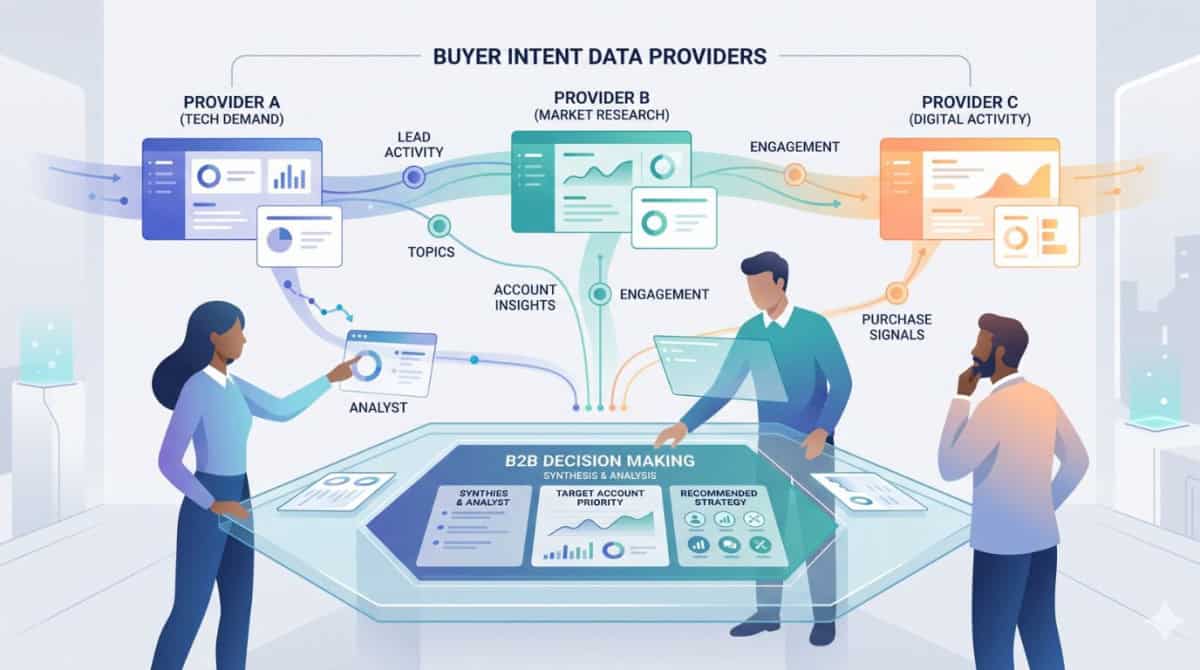
Buyer intent data providers make that kind of precision possible. By aggregating signals from across the web — the articles companies are reading, the review sites they are visiting, the competitor comparisons they are making — intent data platforms reveal which accounts are in an active buying cycle right now. In this guide, we explore what separates strong intent data providers from weak ones, how to evaluate your options, and how to integrate intent data into a sales strategy that actually drives results.
What Is Buyer Intent Data and Where Does It Come From?
Buyer intent data is a collection of behavioral signals that indicate a company or individual is actively researching a product, service, or category. These signals are gathered from a variety of sources across the digital ecosystem, including publisher networks, review sites, industry forums, job boards, and content syndication platforms.
When an employee at a target company spends time reading articles about B2B lead generation software, visits G2 to compare vendor reviews, and downloads an ebook on website visitor tracking, each of those actions generates an intent signal. Intent data platforms collect and aggregate these signals across millions of B2B professionals and thousands of companies, then deliver them to you as actionable intelligence about which accounts are surging in research activity related to your solution category.
There are two primary types of intent data. First-party intent data is collected from your own digital properties — your website, your app, your content — and gives you insight into how known and anonymous prospects interact with your brand directly. Third-party intent data is collected by external platforms from activity across the broader web, giving you a view into buyer behavior that happens outside your owned channels. The most powerful intent data programs combine both types to create a 360-degree view of buyer activity.
Why Buyer Intent Data Providers Are Essential for B2B Sales Performance
The traditional B2B outbound model is built on spray-and-pray prospecting. Sales reps work through lists of companies that fit their ideal customer profile and contact them repeatedly until someone responds — regardless of whether those companies have any active interest in buying. It is expensive, time-consuming, and increasingly ineffective as buyer attention becomes more fragmented.
Intent data fundamentally changes that model. Instead of contacting every company that fits your ICP, you prioritize the ones showing active research behavior that indicates they are in the market right now. According to a study published by Aberdeen Group, companies using intent data in their go-to-market programs experience 2x higher win rates on deals that originate from intent-triggered outreach compared to cold prospecting. That is a dramatic improvement in efficiency that compounds over time across your entire revenue organization.
Gartner research supports this further, finding that 77% of B2B buyers describe their purchasing journey as very complex or difficult. Intent data gives sellers a roadmap through that complexity, helping them reach the right stakeholders at the right stage of the buying journey. Lead Eagle‘s platform is purpose-built to deliver this kind of real-time buying intelligence to B2B sales and marketing teams.
The Key Criteria for Evaluating Buyer Intent Data Providers
Not all intent data is created equal. The market has grown rapidly, and there is significant variation in data quality, coverage, and methodology between providers. Here is how to objectively evaluate your options.
Data Source Diversity: The breadth of sources a provider monitors directly impacts the quality and completeness of their intent signals. Providers that rely on a single publisher network or a narrow content syndication pool will surface only a subset of buyer activity. Look for platforms that aggregate signals from diverse source types — publisher networks, review sites, social platforms, job boards, and direct research intent — to ensure you are capturing a comprehensive picture of buyer behavior.
Signal Freshness: Buyer intent is highly time-sensitive. A company that was actively researching your category three months ago may have already made a purchase decision. Intent data is most valuable when it reflects current activity, not historical patterns. Ask providers how frequently their signals are updated and what their data latency looks like from signal capture to delivery.
Topic Coverage: Every solution category has its own vocabulary of research topics. Make sure the provider covers the specific topics, keywords, and content categories that buyers in your market actually research. Eagle InMarket™ delivers intent data specifically calibrated for B2B technology and service categories, with topic coverage that aligns with the actual research behavior of buyers evaluating data and lead generation platforms.
Company and Contact Match Rates: Intent signals are only actionable if they can be matched to companies and contacts in your CRM or target account list. Evaluate providers on their ability to match intent signals to accounts with accuracy, and understand how their matching methodology works to avoid inflated match rate claims.
Integration Ecosystem: Intent data creates the most value when it flows automatically into your existing workflows. Evaluate the provider’s integration capabilities with your CRM, marketing automation platform, sales engagement tools, and paid media platforms. Seamless data flow eliminates manual processes and ensures your team can act on intent signals without friction.
First-Party vs. Third-Party Intent: Building a Complete Picture
Many B2B companies start their intent data journey with third-party data because it provides coverage across the entire web and does not require any changes to their own digital properties. Third-party intent is valuable for prospecting — finding companies in your target market that are actively researching your category, even if they have never visited your website.
First-party intent data, derived from your own website and content, is generally higher fidelity because it reflects direct engagement with your brand. A company that visits your pricing page three times in a week is sending a much stronger buying signal than one that reads a generic industry article. EagleID™ visitor identification technology captures this first-party intent at both the company and individual contact level, giving your team immediate visibility into which accounts are showing high-engagement behavior on your own properties.
The optimal approach combines both data streams. Use third-party intent to identify companies in early research phases and engage them with top-of-funnel content. As they progress in their buying journey and begin engaging more directly with your website, your first-party data captures those stronger signals, allowing your sales team to escalate their outreach at exactly the right moment.
How to Avoid Common Pitfalls When Working with Intent Data Providers
Even with strong intent data, there are common mistakes that reduce its effectiveness. Understanding these pitfalls upfront helps you design a program that delivers consistent ROI.
One of the most frequent mistakes is treating intent data as a replacement for ICP qualification rather than a supplement to it. A company that is actively researching your category but does not fit your ideal customer profile is still not a good prospect. Always layer intent data on top of firmographic and technographic qualification — not instead of it.
Another common error is using intent data too late in the buying cycle. The highest value of intent signals lies in reaching prospects during their early-to-mid research phase, before they have developed strong vendor preferences. Configure your alerts and workflows to trigger early-stage outreach at the first sign of sustained research activity, not when the surge has already peaked.
Finally, avoid creating generic outreach that ignores the specific intent signal that triggered the contact. If a prospect has been researching website visitor identification, your outreach should be specifically about that topic — not a generic product pitch. Intent data gives you a unique window into what the buyer is thinking about right now, and the most effective teams use that context to craft highly relevant messages.
Integrating Intent Data with Your Retargeting and Paid Media Programs
Intent data is not limited to sales outreach. Some of the highest-ROI applications of buyer intent data involve using it to improve the targeting and efficiency of your paid media programs. By syncing intent-identified account lists into your LinkedIn, Google, and Meta advertising platforms, you can ensure that your ad spend is concentrated on the accounts showing the highest current purchase intent.
This approach, often called intent-based advertising or intent-driven ABM, consistently outperforms traditional demographic and firmographic targeting in terms of cost per qualified lead and cost per opportunity created. Audience Eagle™ automates this process by continuously syncing high-intent account lists to your advertising platforms, ensuring your retargeting campaigns are always reaching the accounts most likely to convert — without requiring manual list refreshes.
Measuring the Impact of Your Intent Data Program
Like any sales and marketing investment, your intent data program needs clear success metrics to justify ongoing investment and guide optimization. Here are the primary KPIs to track.
Intent-influenced pipeline is the most important measure. Track opportunities where intent data triggered or accelerated the outreach that led to an initial meeting or discovery call. This gives you direct attribution for the revenue impact of your intent data investment.
Win rate on intent-triggered opportunities compared to your baseline win rate is a powerful efficiency metric. If intent-triggered deals close at 2x or 3x your normal win rate, that differential quantifies the quality advantage that intent data provides.
Time to first meeting — the number of days from a prospect’s first visible intent signal to a booked discovery call — measures how quickly your team is capitalizing on buying windows. This metric improves as your workflows become more automated and your response playbooks become more refined.
Frequently Asked Questions
What is the difference between intent data and lead data?
Lead data typically refers to contact information for individuals who have expressed some level of direct interest in your company. Intent data refers to behavioral signals that indicate research activity, which may be happening entirely outside your owned channels. Intent data tells you who is in the market; lead data tells you who has raised their hand. The two work best together.
How do buyer intent data providers collect their data?
Providers aggregate signals from publisher and content syndication networks, B2B review sites, social listening, job posting analysis, and first-party website data. They use proprietary algorithms to identify when a company’s content consumption around a specific topic represents a statistically significant surge in research activity, which is then flagged as an intent signal.
Is intent data GDPR and CCPA compliant?
Reputable providers take compliance seriously and design their data collection and processing practices to align with major privacy regulations. However, compliance approaches vary, and you should always review a provider’s data processing agreements and compliance documentation before deploying their data.
How long does an intent signal stay active?
Intent signals have a shelf life that varies by topic and provider. Most platforms consider a signal relevant for 30–90 days after initial detection. The key is to act quickly — the sooner your team follows up on an intent signal, the more relevant and timely the outreach will be.
Can intent data help with customer expansion and retention?
Yes. If an existing customer is researching competitor products or alternative solutions, that is a powerful early warning signal that gives your customer success team time to proactively address any concerns before the account is at risk. Similarly, intent data can surface expansion opportunities when a customer begins researching capabilities adjacent to their current usage.
How many intent topics should I track?
Start focused. Tracking too many topics dilutes your team’s ability to prioritize and act effectively on the signals. Begin with five to ten topics that are most directly related to your core value proposition and the most common research paths your buyers take. As you identify which topics correlate most strongly with eventual purchase, expand your coverage strategically.
What size of business benefits most from intent data?
Intent data provides the greatest ROI for B2B companies with defined target account lists, complex sales cycles of 30 days or longer, and multiple stakeholders involved in the purchasing decision. This typically means mid-market and enterprise-focused businesses, though growth-stage companies with focused ICPs can also see strong returns from well-implemented intent data programs.
Want to see how AI-powered intent data can transform your sales pipeline? Discover how Eagle Outbound™ combines buyer intent data with precision cold email outreach to help your team reach the right prospects at exactly the right moment in their buying journey.
Related Posts
How Website Visitor Identification Software Converts Anonymous Traffic into Qualified B2B Leads
Did you know that over 98% of your website visitors leave without ever filling out…

The Ultimate Cold Email Lead Generation Guide for 2026
Cold Email Evolution: Staying Ahead in 2026 As technological landscapes and digital communication norms continue…