

AI Search Optimization ROI Just Made It the Highest-ROI Channel in Digital Marketing: What That Means for Your Business
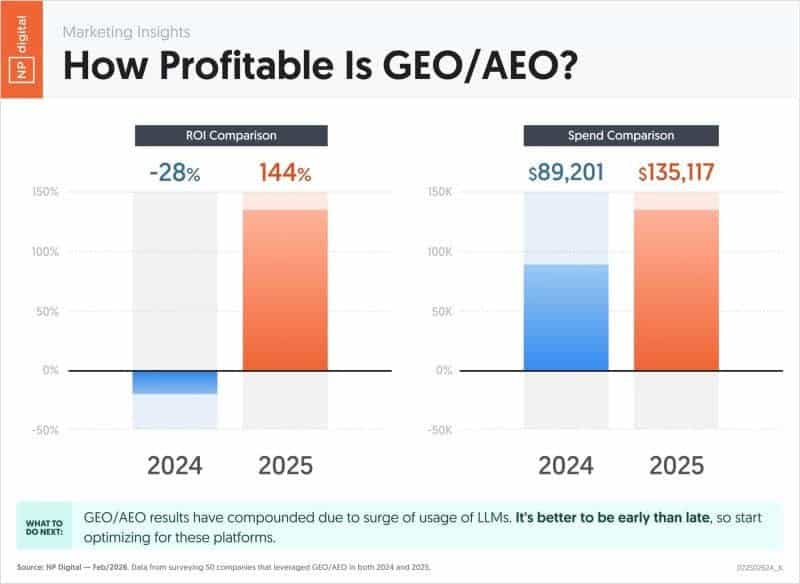
In 2025, companies investing in AI search optimization ROI saw an average return of positive 144 percent.
That is not a projection. That is actual ROI data shared by Neil Patel of NP Digital, one of the most widely cited voices in digital marketing. The channel that most businesses were still debating quietly became one of the highest-returning investments available.
The context makes the number even more impressive. In 2024, the same category of work returned negative 28 percent. AI platforms were still early. User adoption had not reached the tipping point. The groundwork was being laid, but the payoff had not arrived yet. For those looking to understand how AI impacts modern marketing strategies, check out AI in marketing.
Then AI search usage exploded. And the brands that had already optimized were in position to capture that demand. Average investment only went from roughly $89,000 in 2024 to about $135,000 in 2025. The budget increase was modest. The return was not.
This is exactly the shift that our Search Eagle™ service was built for.
The Market Moved: Maximizing AI Search Optimization ROI Before Competitors
Two things happened simultaneously in 2025.
First, AI search adoption grew faster than anyone predicted. ChatGPT, Google AI Overviews, Perplexity, Copilot, and Claude all saw massive user surges. Conductor’s 2026 AEO/GEO Benchmarks Report analyzed over 3.3 billion sessions and 17 million AI-generated responses across more than 13,000 domains. Their findings show AI referral traffic now accounts for 1.08 percent of all website sessions and is growing at 1 percent month over month. That sounds small until you look at the conversion data. AI-referred visitors convert at significantly higher rates than traditional organic traffic.
Second, the brands that started optimizing for AI search early had a full year of compounding authority working in their favor. When the wave of new users arrived, those brands were already structured, cited, and trusted by the AI models generating the answers. Everyone else was invisible at the exact moment visibility started to matter.
Neil Patel expects the returns to accelerate further in 2026 as LLM usage continues to rise.
Why AI Search Optimization ROI Compounds Instead of Plateauing
This is where most business owners and marketing leaders get it wrong. They evaluate AI search optimization the way they evaluate paid ads. Put a dollar in, get a result out, measure it the same day.
AEO (Answer Engine Optimization) and GEO (Generative Engine Optimization) do not work that way. They compound.
Every piece of content you structure for AI extraction makes the next piece more likely to get cited. Every citation builds entity authority. Every authority signal makes the AI model more confident in recommending your brand the next time someone asks a question in your category.
The brands that moved in 2024 and early 2025 built this foundation. When usage doubled and tripled, that foundation paid off at a rate that was mathematically impossible during the low-adoption phase. That is why the ROI went from negative to explosive in a single year.
Conductor’s State of AEO/GEO report confirmed it. Ninety-seven percent of companies reported a positive impact from their AI search optimization work in 2025. And 94 percent plan to increase their investment in 2026. The early experiment phase is over. This is now a mainstream channel with real budget behind it.
AI Search Optimization ROI Matters as 60 Percent of Searches End Without a Click
Here is why this matters for your business right now.
Roughly 60 percent of Google searches in the US now end without the user clicking through to any website. That number was 26 percent in 2022. AI Overviews, featured snippets, and conversational AI tools are answering questions directly. Users get what they need without ever visiting your site.
If your brand is not part of those AI-generated answers, you are not losing a ranking. You are losing the chance to exist in the conversation at all.
But the data also shows an upside. Sources that get cited by AI answer engines see 27 percent higher click-through rates compared to traditional search placements. The volume is lower. The quality is dramatically higher. Companies that established dedicated AEO strategies early are seeing 3.4 times more answer engine traffic than competitors who waited.
This is why we built Search Eagle.
ChatGPT Drives 87 Percent of AI Referral Traffic
Of all the AI-driven traffic flowing to websites today, ChatGPT accounts for 87.4 percent. Perplexity is second. Gemini and Copilot show up in certain verticals but are not yet moving the needle broadly.
If your content does not show up when someone asks ChatGPT about your industry, your service category, or the problem you solve, you have a visibility gap that widens every month.
AI traffic converts higher because the user behavior is different. People using ChatGPT or Perplexity do their research inside the platform. By the time they click through to your site, they have already formed an opinion. They are closer to a decision. They are not comparison shopping across ten browser tabs. They are acting on a recommendation from a source they trust.
Search Eagle optimizes your brand to be that trusted source across every major AI platform.
This Is Not About Rankings Anymore
Traditional SEO trained us to think in terms of positions. Page one. Top three. Featured snippet. Those still matter for Google organic search, and Search Eagle covers that layer too. But AEO and GEO operate on a completely different logic.
AI models do not rank websites. They synthesize answers. They pull from sources they consider authoritative, clear, and factually dense. They cite brands that show up consistently across trusted contexts. They recommend companies that have structured their content in ways AI can parse and verify.
Becoming the brand that AI trusts enough to mention is a fundamentally different goal than ranking for a keyword. It requires structured data, entity authority, verifiable claims, and consistent presence across the contexts that AI models draw from.
Search Eagle handles both sides. If you need the full picture, Search Eagle gives you AEO, GEO, and traditional SEO working together. If you want to focus purely on AI search visibility, Search Eagle/AI delivers specialized AEO and GEO optimization without the traditional SEO component.
The Window to Move First Is Closing
The compounding dynamics of AI search optimization mean the gap between leaders and laggards widens over time, not narrows. Every month a competitor builds citation authority is a month you fall further behind.
If you are still evaluating whether AI search optimization is worth it, the market has already answered that question. One hundred and forty-four percent ROI. Ninety-seven percent of companies reporting positive results. Ninety-four percent increasing their investment. And we are still in the early innings of AI search adoption.
The question is not whether your brand should be optimized for AI search. The question is whether you will be the brand AI trusts enough to recommend, or the one it never mentions.
Find out where your brand stands in AI search today. Request a free AI Visibility Audit and our team will show you exactly how your brand appears (or does not appear) across ChatGPT, Perplexity, Google AI Overviews, and the other AI platforms your prospects already use to make decisions. Call (707) 329-3313 or book online.
Sources: Neil Patel / NP Digital GEO/AEO ROI analysis (2025), Conductor 2026 AEO/GEO Benchmarks Report, Conductor State of AEO/GEO in 2026 CMO Investment Report, SparkToro 2024 Zero-Click Search Study.
Related Posts

Why the $350 Roofing Lead Benchmark Is Costing You Money
If you've spent any time optimizing your roofing company's digital marketing, you've probably heard the…

Your Customers Are Asking AI Where to Go: Is Your Business Ready for AI Local Search Optimization?
Right now, a potential customer in your city is opening ChatGPT on their phone. They’re…