

Your Customers Are Asking AI Where to Go: Is Your Business Ready for AI Local Search Optimization?

Right now, a potential customer in your city is opening ChatGPT on their phone. They’re not typing a query into Google—they’re asking a question powered by AI Local Search Optimization: “What’s the best [your service] near me?” or “Who should I call for [your specialty] in [your city]?”
And the AI gives them one answer. Maybe two. Not a page of ten results to scroll through, but a direct recommendation—presented with confidence.
If that recommendation isn’t your business, it’s your competitor’s. And you probably don’t even know it’s happening.
This is the shift that’s rewriting local search, and most local businesses are completely unprepared for it.
The Old Playbook Still Matters for AI Local Search Optimization
If you’ve invested in local SEO over the past several years, that work hasn’t been wasted. Google Business Profile optimization, consistent NAP citations across directories, review generation, and locally-focused website content still drive traditional search visibility. Those foundations aren’t going away.
But a second layer has emerged on top of them. Large language models, the AI systems behind ChatGPT,
Google’s AI Overviews, Perplexity, Claude, and Gemini, are now making decisions about which businesses to recommend to users. And the way they make those decisions is fundamentally different from how Google’s traditional algorithm works.
Traditional search gives you a ranked list and lets the user choose. AI search picks a winner for the user. That distinction changes everything about what it takes to be visible.
How AI Local Search Optimization Understands Your Customer’s Location
Here’s a detail that catches most business owners off guard: when someone asks Google for a nearby business, Google knows their precise location via GPS and serves hyper-local results based on proximity. LLMs don’t work that way.
AI models infer location from the signals available to them, things like the user’s general region (derived from their app settings or IP), explicit mentions of location in the query, and the geographic signals embedded in your digital presence. They don’t triangulate your customer’s position on a map. They piece together a best guess based on the data they’ve collected about your business across the web.
That means the location signals you send need to be explicit, consistent, and everywhere. If your website content mentions the neighborhoods you serve, if your reviews reference local landmarks, if your schema markup defines your service area down to the zip code level, the AI has what it needs to connect you to locally-relevant queries. Here is an article to learn more about the importance of local relevance.
If those signals are thin or inconsistent, the model picks someone else.
Your “Entity” Is Your AI Reputation
AI models understand your business as an entity, a collection of attributes, relationships, and trust signals assembled from every corner of the internet where your brand appears.
Your Google Business Profile. Your Bing Places listing. Your Yelp page. Your industry directory listings. Your website. Your social media profiles. Customer reviews. Third-party blog mentions. Local news citations. All of it feeds into a composite picture that the AI uses to decide whether it trusts your business enough to recommend.
When all of those sources tell the same story, same name, same address, same phone number, same business description, same service categories, the model’s confidence is high and your chances of being cited go up.
When there are contradictions, even minor ones, confidence drops. And AI models are built to avoid recommending businesses they aren’t sure about. A mismatched phone number on an old directory listing or a slightly different business name on Facebook versus your website can be enough to cost you a recommendation.
This is where most local businesses have a blind spot. They optimized for Google and assumed the rest would take care of itself. In an AI-driven world, every platform matters because they all feed the model.
The Bing Places Blind Spot for AI Local Search Optimization

Here’s one that costs businesses visibility every single day: ChatGPT pulls its local search data from Bing’s index. If your Bing Places profile is missing, incomplete, or out of date, you are functionally invisible to the most widely-used AI assistant in the world.
Most businesses treat Bing as an afterthought because its search engine market share is small. But its role as ChatGPT’s data backbone makes it one of the highest-impact local listings you can optimize right now. Learn more about optimizing Bing Places for business visibility.
The same applies to Apple Maps and Waze. These platforms feed data into AI ecosystems in ways that weren’t relevant two years ago. Accuracy on all of them reinforces the consistency that AI models reward.
Schema Markup for AI Local Search Optimization: Speaking the AI Language
Structured data markup has always been a good SEO practice. For AI visibility, it’s become a requirement.
LocalBusiness schema, FAQ schema, service area definitions, product attributes, review markup, and department-level schema all serve the same purpose: they translate your business identity into machine-readable format so that AI models can interpret it without ambiguity.
The more thorough your schema implementation, the easier it is for AI to parse your entity, and the more likely it is to cite you. This isn’t about gaming a system. It’s about reducing friction between your business information and the models that are trying to understand it.
Creating Content That Gets Cited in AI Local Search Optimization
The content that earns AI citations looks different from the content that traditionally performed well in local
SEO. AI models favor content that answers specific questions in clear, structured formats. Comparison pieces, cost guides, FAQs broken down by neighborhood or service type, and explainer content that addresses real local conditions all translate well into the kind of responses AI generates.
Generic “We serve [City Name]” landing pages don’t carry weight anymore. If you’re an HVAC company in Phoenix, content about how extreme desert heat affects specific types of systems, and what local homeowners should know about maintenance schedules in that climate, tells the AI you actually understand the market. That kind of specificity is what earns a citation over a competitor with a more generic page.
Reviews Are Now a Data Source
Beyond their obvious role in influencing customer decisions, reviews have become an input that AI models actively use to understand your business.
The specific language in reviews matters. When a customer mentions the service they received, the neighborhood they’re in, or the specific outcome of their experience, those details become data points that AI uses to connect your business to relevant queries.
A strategy that only focuses on accumulating star ratings misses this. Encouraging customers to be specific in their reviews, mentioning the service, the location, the result, gives AI models richer material to work with when deciding whether to recommend you.
Internal Linking Creates Contextual Maps for AI
One of the simplest and most overlooked signals: how the pages on your website connect to each other.
When your service pages, location pages, blog content, and FAQ sections are linked together in a logical structure, AI models can follow those connections to build a more complete understanding of your business. Orphaned pages that sit disconnected from the rest of your site are harder for models to interpret and less likely to appear in generated answers.
Internal linking is essentially a roadmap you’re giving the AI, showing it how your services, locations, and expertise relate to each other.
This Is What Search Eagle Was Built For
Every challenge described in this article, entity consistency, schema implementation, AI-optimized content, citation management, Bing Places optimization, review strategy, is exactly what Search Eagle from Lead Eagle addresses.
Search Eagle is our AEO (Answer Engine Optimization) and GEO (Generative Engine Optimization) service, purpose-built to get your brand cited, recommended, and trusted by the AI platforms that are rapidly becoming the primary way people discover local businesses.
We start with a free AI Visibility Audit that shows you exactly how your business currently appears (or fails to appear) across ChatGPT, Perplexity, Google AI Mode, Gemini, and Claude. We show you where your
competitors are already being cited. We identify the gaps in your entity signals, structured data, and content strategy.
From there, Search Eagle implements the full stack: schema markup and structured data optimization, entity synchronization across every platform that feeds AI models, content strategy built around the formats AI actually cites, authority and citation building to strengthen your brand’s trust signals, and continuous monitoring so your visibility compounds over time instead of degrading.
The traditional SEO foundation you’ve built isn’t being replaced. It’s being extended into a channel that your competitors haven’t figured out yet. And the businesses that establish authority in AI search now will have a structural advantage that becomes increasingly difficult to overcome.
Gartner projects a 50% drop in organic search traffic by 2028 as AI-driven discovery takes over. The window to position your business ahead of that shift is right now.
Get your free AI Visibility Audit at leadeagle.io/search-eagle-aeo-geo-seo Or call us directly: (707) 329-3313
Related Posts

Why the $350 Roofing Lead Benchmark Is Costing You Money
If you've spent any time optimizing your roofing company's digital marketing, you've probably heard the…
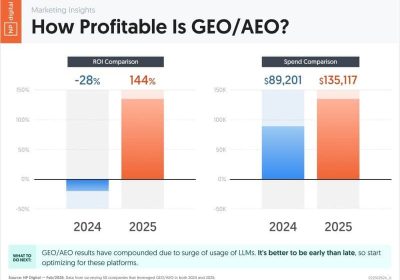
AI Search Optimization ROI Just Made It the Highest-ROI Channel in Digital Marketing: What That Means for Your Business
In 2025, companies investing in AI search optimization ROI saw an average return of positive…